You are surfing a games lobby, and right below the title, you come across a number: “96.5% RTP. You may have been looking at this number hundreds of times already and never given it a second thought. Or maybe you are wondering whether it’s just a marketing strategy or a thing that really plays into the gameplay itself. Well, it’s both, and at the same time, it is not. The RTP is one of the few numerical terms in the online gaming world that is backed by solid math, and once you know its meaning, the way you perceive each game that you open will be changed forever.
This blog explains what is RTP, how RTP works, and most importantly, what RTP does not say.
What Is RTP? The Simple Definition
RTP stands for Return to Player. It refers to a figure that shows the theoretical percentage of the total sum of money that will be paid back to the player through winnings after playing a game.
If the RTP of a particular game is 96%, it basically means that for every 100 coins that you play in the game, 96 coins are given back to you theoretically.
A few things to lock in early:
- RTP is a long-run average, not a promise for any single round
- It's calculated using the game's math model and confirmed through extensive simulation or historical round data
- It applies across the entire player base over millions of rounds, not to any one person's session
Once you understand this baseline, the rest of how RTP works starts to make a lot more sense.
Common RTP Misconceptions Players Should Know
- "If a game has 97% RTP, will I get most of my coins back?" Not necessarily in one sitting. RTP plays out over a huge number of rounds, not a single session.
- "Does a low RTP mean the game is rigged?" No. A lower RTP simply reflects a different math model, it's disclosed, not hidden, and it's built into how the game is designed from day one.
- "Can RTP change while I'm playing?" For a given game version, no. The RTP is fixed in the game's programming and doesn't shift mid-session based on your activity.
- "Is RTP the same as my odds of winning a specific round?" Not quite, RTP and odds are related but different concepts, and mixing them up is one of the most common mistakes.
Why RTP and Volatility Matter to Players
Knowing what is RTP and how to read an RTP percentage gives you a more informed way to explore any game lobby.
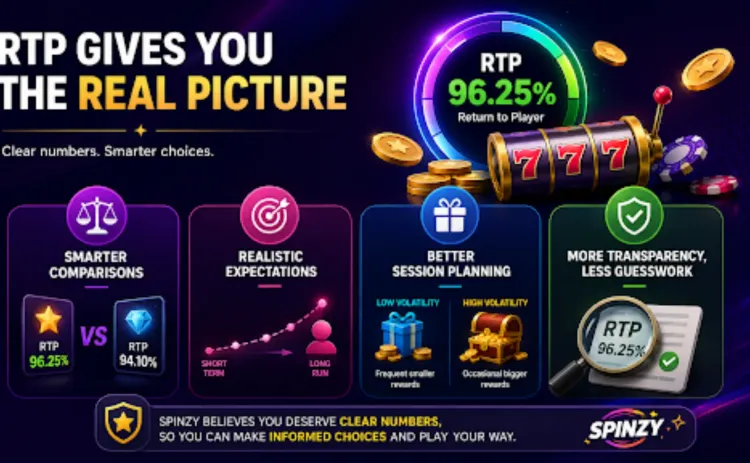
- Smarter comparisons. When two similar games are sitting side by side, RTP gives you an objective way to compare them beyond just theme or graphics.
- Realistic expectations. Understanding that RTP is a long-run figure keeps your expectations grounded, session to session.
- Better session planning. Pairing RTP with volatility (more on that below) helps you pick games that match the kind of experience you're looking for, frequent smaller rewards or occasional bigger ones.
- More transparency, less guesswork. Games that display RTP openly are giving you real information about how they're built, rather than leaving you to guess.
This is exactly the kind of information Spinzy believes players deserve, clear numbers, explained clearly, so you can make your own informed choices about what to play.
Who Should Actually Pay Attention to RTP?
RTP isn't a niche stat for math enthusiasts; it's genuinely useful information for a wide range of players:
- Players who enjoy comparing multiple games before settling into one
- Anyone who wants to understand why some titles feel different to play than others
- New players trying to get familiar with how sweepstakes-style games are structured
- Players who prefer transparency over guesswork when exploring a game library
In short, if you play games regularly, RTP is worth knowing. If you're brand new to the sweepstakes gaming space, it's one of the first concepts worth wrapping your head around.
How RTP Works: Breaking Down the RTP Calculation
So how does RTP actually get its number? At the core, every game runs on a random number generator (RNG), software that produces unpredictable, independent outcomes for every round, the same way shuffling a deck produces a random order each time.
The RTP calculation looks roughly like this:
Total amount returned to players ÷ Total amount played = RTP
This ratio is calculated using either extensive simulated data (running millions of virtual rounds) or aggregated real-round history. That's why RTP is described as a "theoretical" figure, it's the expected outcome over a very large sample, not a fixed script for the next ten rounds you play.
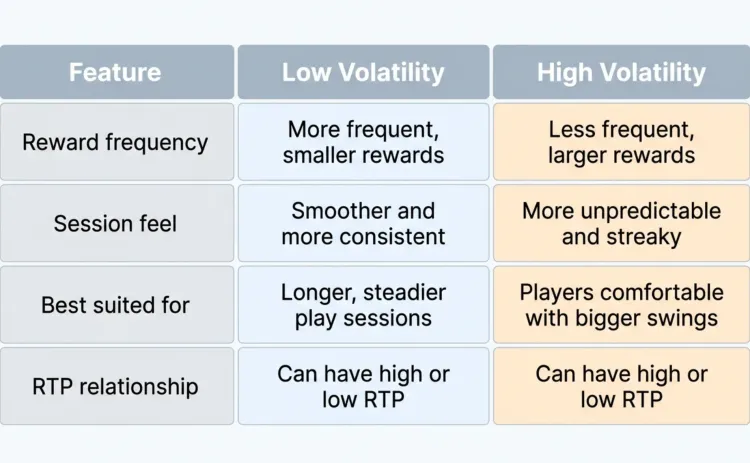
There's a second concept that works alongside RTP: volatility (sometimes called variance). Volatility describes how rewards are distributed, not how much comes back overall.
RTP Limitations: What You Can Realistically Expect
- RTP does not tell you what will happen in your next round, your next ten rounds, or your next session
- A high RTP percentage does not eliminate the natural unpredictability built into every round
- RTP figures are theoretical and calculated over a scale (millions of rounds) that no single player will ever personally reach
- Short sessions may look nothing like the long-run RTP average, that's expected, not unusual
- Over an extended period of play across many players, results tend to trend toward the disclosed RTP figure
- Your personal outcome in any given session depends on RNG-driven variance, not on manipulating or "solving" the RTP
- Sweeps Coin rewards are promotional in nature and are always subject to eligibility rules, applicable terms, and the laws of the jurisdiction a player is located in
- No-purchase-necessary participation options remain available, and Gold Coin play is intended purely for entertainment purposes
Treating RTP as a general guide rather than a session-by-session predictor is the healthiest and most accurate way to use the number.
RTP Comparison Across Different Game Types
Different game categories tend to carry different typical RTP ranges, largely because of how each type is mathematically structured.
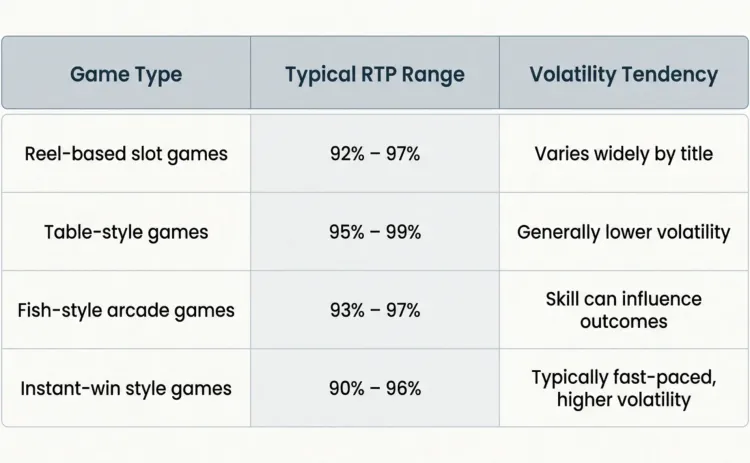
The takeaway isn't "always pick the highest number." It's that RTP gives you a consistent, comparable metric across very different types of games, something you can use alongside your own preferences for pace and volatility.
RTP in Action: Comparing Two Games Side-by-Side
Consider two reel-based games that are next to each other in the same lobby:
- In Game A, the RTP is 97%, with low volatility. The rewards will generally be delivered frequently, though in smaller amounts, thus working well for players who prefer steady play for long periods of time
- In Game B, the RTP is 94%, with high volatility. In this game, the rewards will not occur as often but will be quite large, which is suitable for players who do not have problems with spending unpredictable intervals for the sake of higher rewards.
Neither of these two games can be called better, as each of them works according to a certain strategy and is aimed at a certain type of player. This is precisely the idea behind RTP usage, as it should help you find a game that will suit your preferences, rather than chasing the largest percentage in the lobby.
If you're exploring reward-based platforms, it's worth noting that Spinzy currently offers the promo code Spinzy7, which adds 7% extra on both Sweeps Coins and Gold Coins, a small detail worth knowing if you're comparing where to spend your time.
Final Takeaway on RTP
Understanding what is RTP is really simple when all the misconceptions around it are stripped away. RTP is basically an average that provides insights on how the game is mathematically structured and not a prediction of how the next gaming session will go. Understanding the RTP and coupling it with the volatility of the game gives you the ability to approach any library of games armed with facts.
Transparency regarding the mathematical structure of games at Spinzy means that gamers get to understand how the games operate. Are you up for it? Head over to the Spinzy library of games.
FAQs
1. Does a game's RTP ever get updated or changed?
Yes, occasionally. Game providers sometimes release updated versions of a title with an adjusted RTP, but this is always disclosed as a new version, the RTP of the version you're actively playing stays fixed.
2. Why is it possible that similar games have different RTP values?
RTP is part of the math structure of the games themselves, which means that two games that appear identical could still have entirely different programming when it comes to return value.
3. Can I find out myself what the RTP level of the game is before starting?
Usually, RTP is provided right in the lobby of the game, where one can see this information on the info or payout table of the game.
4. Can longer play help me reach the RTP level of the game?
More time spent playing helps you get close to the average, but RTP is based on a scale so large that even the longest game won't be able to reflect it precisely.
5. Are RTP percentages regulated or independently checked?
In many markets, RTP figures are verified through independent testing processes as part of standard industry practice, which is part of why the percentage is considered a reliable, math-based figure rather than a marketing claim.
Authored and Validated by: A Sweepstakes Gaming Expert