You notice a long losing streak. Or three bonus rounds back to back. And you start wondering: is this random, or is something deciding what I get?
RNG stands for Random Number Generator. It's the system behind every spin, every card draw, every outcome in a sweepstakes game. Each round is independent of the last one.
Understanding what RNG is and how it actually works beats believing what other players tell you about it.
What Is RNG in Games and Why Does It Matter?
An RNG is software running constantly, generating new random numbers even when no one's spinning anything. The moment you hit Spin, Deal, or Play, the game grabs whatever number is current and turns it into your result.
It picks one outcome out of millions of possible combinations. Nothing about your win or loss factors into that pick, because the RNG doesn't know who's playing or what they need.
Licensed sweepstakes platform runs RNG systems tested by independent labs and audited on a regular basis. That's what makes manipulation so hard to pull off.
Three Things Players Worry About Most
"The game is due to pay."
Random systems don't have a memory. A machine that hasn't paid out a bonus in hours has exactly the same odds on the next spin as it did three hours ago.
"I won yesterday, so today's probably unlucky."
Every round stands on its own. Yesterday's result has zero pull on today's.
"The platform is changing my odds behind the scenes."
Licensed platforms can't quietly adjust one player's odds on a whim. The math behind the game, RNG and RTP (Return to player) both stay fixed unless the whole certified game version gets swapped out.
What a Certified RNG Actually Gets You
- Every outcome gets generated independently, no exceptions
- Nothing that happened on your last spin leans on this one
- Every eligible player works from the same mathematical odds
- Independent testing means someone besides the platform itself checked the math
- Fair math is what makes this responsible entertainment
Platforms like Spinzy.ai build fairness into the product itself, right alongside the parts that make the games fun to play.
Eligibility and Compliance: The Non-Negotiables
Fair RNG doesn't override the legal side of things. You still need to:
- Meet your state's eligibility rules
- Be at or above the platform's minimum age
- Complete identity verification before redeeming any Sweeps Coins
- Know that availability shifts state by state, sometimes fast
Read the Terms and Conditions before you play. State rules shift, and lately they've been shifting fast.
How RNG Works in Sweepstakes Games
Picture a number machine running full speed, every second, whether or not anyone's playing.
Here's what happens in the half-second after you hit Spin:
- The RNG has been generating numbers this whole time, nonstop
- You press Spin
- The game grabs whatever number is current at that exact instant
- That number maps to one specific outcome
- The reels show you the symbols that match it
Because the generator never pauses, a shift of a few milliseconds changes everything. Timing decides your result. The spin before it has no vote.
RNG vs. Common Player Beliefs
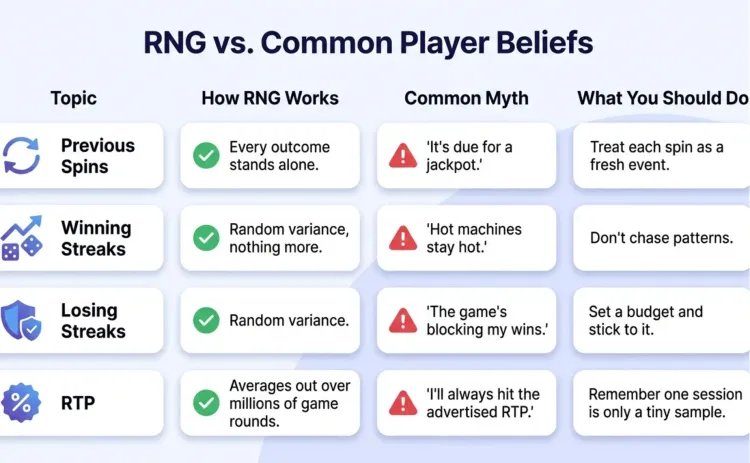
RNG Myths vs. Reality: The ones that trip up experienced players
You already know the entry-level myths by now. Due for a jackpot. Hot streaks. Wins getting blocked. All covered above.
There's a second layer, though. These surface once you've already accepted the first ones, and they're trickier to catch because they sound reasonable. Worth knowing before you play on Spinzy.ai, or anywhere else running certified RNG.
Myth: “Certified RNG means the platform can never change my experience.”
Reality: Certification locks in the algorithm and the settings approved with it. That's it. Promotions, bonus triggers, and which RTP setting is actually live can all shift without touching that certification at all.
What this means for you: Ask what changed. Don't assume "still certified" means "nothing changed.
Myth: “Fair odds mean things even out. I'm due.”
Reality: Fair means the math is unbiased. Two players with identical odds can land in very different places for weeks, sometimes months.
What this means for you: Variance is just what randomness looks like up close, over any single stretch of play.
Myth: “Provably fair beats lab-certified RNG. Or the other way around.”
Reality: They check different things. Provably fair lets you verify one specific round after it ends. Lab certification tests the whole algorithm before you ever place a bet.
What this means for you: Ask what a platform actually has, and why. Think of them as two tools measuring two different things.
Myth: “I keep seeing the same symbols cluster. That's a pattern.”
Reality: Random data clusters constantly. Three of the same symbol in a row is just what real randomness looks like sometimes.
What this means for you: A cluster like that is what honest math produces from time to time.
Myth: “Bigger jackpots mean worse odds everywhere else in the game.”
Reality: Progressive contributions usually sit in their own pocket of the bet, separate from base game math. Usually, it varies by title.
What this means for you: Check the specific game's rules and paytable instead of guessing.
Inside an Actual RNG Certification Test
Gaming Laboratories International (GLI) and iTech Labs are the two names that come up most often. Both run certification testing for RNG systems used by licensed gaming providers.
A typical certification run looks at:
- Millions of generated outcomes
- Statistical randomness across that output
- Whether results repeat cleanly across multiple runs
- Compliance with the relevant regulatory standard
Running millions of simulated rounds is what actually rules out hidden patterns and confirms the outcomes meet accepted randomness standards.
Key takeaways
- Large-scale statistical testing verifies randomness
- Results have to clear strict probability tests
- Certified games get reviewed periodically to stay in compliance
Beyond Certification: How RNG integrity gets watched after a game goes live
Most coverage of RNG stops right here: a lab tested it once, so it's fair.
Here's what happens after that first test. This part lives inside compliance teams and game studios, which is exactly why it rarely makes it into a blog post.
Re-certification happens on a regular cycle
Games get re-tested when the math changes, when the platform migrates to new servers, when it launches in a new jurisdiction, or on a set schedule, usually once a year. Miss one of those triggers and the certificate on file stops matching what's actually running.
Operators watch for drift
Theoretical RTP is a long-run number. So compliance teams track actual payout percentages against that number over rolling windows, 30 days, 90 days, a full year, across large sample sizes.
A small sample looks weird constantly. That's just noise. A big sample that stays off for a long stretch gets flagged and investigated.
Randomness gets tested, over and over
A certified algorithm still has to pass statistical batteries: chi-square tests, runs tests, broader suites built for exactly this purpose. Real output gets measured against those tests, again and again, for as long as the game runs.
Provably fair checks something certification alone can't
Crypto-adjacent platforms increasingly use a client seed, a server seed, and a nonce, combined through a hash you can check yourself after a round ends. That verifies one specific spin wasn't altered after the fact.
Lab certification validates the entire algorithm before you ever place a bet. The strongest setups end up using both.
At scale, this becomes a full-time job
A platform running dozens of games across a dozen states has to track which certified configuration is live in which market, and keep re-certification current everywhere at once. None of that shows up in a paytable.
It's invisible to players, and it's usually the real difference between a platform that treats fairness as infrastructure and one that treats it as a marketing line. Worth asking about wherever you play.
What Fair RNG Doesn't Promise You
A fair RNG still won't guarantee how tonight goes.
- Winning and losing streaks are just what randomness produces naturally
- RTP is a long-term figure, built from way more sessions than just yours
- No betting strategy beats a properly functioning RNG over time
- More playtime doesn't inch you closer to a bonus or a redemption
Knowing this is what keeps you from chasing losses or falling for some "system" you read about online.
What Compliance Pros Actually Check
Fair software is only part of the picture. People who work in gaming compliance tend to check the same three things: certified RNG testing, published RTP where it's available, and independent lab certification behind both.
Where This Leaves You
RNG is the technology keeping every spin, card draw, and round independent and unpredictable. Streaks happen, winning and losing both, simply because that's how randomness behaves over any given stretch. Certified systems are built to keep the outcomes fair over the long run.
None of that replaces good judgment. Understand how the math actually works, play within a budget you set ahead of time, and stick to licensed platforms running independently tested software.
Learn more about how Spinzy protects fair gameplay in our Fair Play & RNG Policy
FAQs
1. What is RNG in games?
A Random Number Generator creates an unpredictable outcome for every round, independent of whatever came before.
2. Can RNG be manipulated?
Licensed platforms run RNG systems that get independently tested specifically to prevent that. Certified games are built to resist predictable or manipulated outcomes.
3. Does RNG guarantee a win after a losing streak?
No. Every spin is independent. Previous losses don't raise your odds on the next one.
4. Is RNG the same thing as RTP?
No. RNG generates the random outcome. RTP estimates the percentage returned to players over millions of rounds. Different measurement entirely.
5. How do I know if a sweepstakes game is actually fair?
Stick to providers using independently certified RNG, and platforms that explain their rules and eligibility requirements clearly instead of burying them.
Authored and Validated by:
The Sweepstake Expert