You have heard it a hundred times. A radio ad ends with a fast voice saying "no purchase necessary." Maybe you rolled your eyes and figured it was legal cover, nothing more. Here is the truth. It is not a trick. It is real, backed by federal law, and it exists so anyone can win a prize, whether they spend money or not. At Spinzy, a US sweepstakes casino, every entry, free or paid, has the same odds of winning. That is the no-purchase-necessary law, working exactly as intended.
What Is the No Purchase Necessary Law?
The no-purchase-necessary law says a company cannot require you to pay just to enter a game of chance. If a prize is being handed out based on luck, everyone needs a free way in. No exceptions.
This idea is older than most people assume. Lawmakers in the mid-1800s got tired of scammers running fake lotteries to drain people's pockets, so they drew a line. Only the government could run a true lottery. Everyone else had to offer a free path in, or shut the promotion down.
A few agencies keep this alive today. The FTC goes after false or misleading sweepstakes ads. The FCC watches promotions running on TV, radio, and online media. The USPS enforces the Deceptive Mail Prevention and Enforcement Act for anything sent by mail. And State Attorneys General enforce their own state rules, which most articles skip entirely. That last point matters, because a federal rule is only half the picture. States add their own layers on top.
Sweepstakes vs. Lottery: The Formula
Nearly every rule around sweepstakes traces back to one formula. Prize plus Chance plus Consideration equals Lottery.
- Prize: Something worth having. Example: Cash, coins, gift cards
- Chance: The winner is picked at random. Example: A random drawing
- Consideration: What you give up to enter. Example: Money, or serious effort
Only the government can legally run a lottery. So how does a private business, a fast food chain, a sweepstakes casino like Spinzy, get to give away real prizes? They remove one piece. Take away consideration, and a lottery becomes a legal sweepstakes. No consideration, no legal issue.
What Counts as Paying to Enter?
Paying does not just mean handing over cash. Monetary consideration is the obvious kind: buying a product, paying a fee, signing up for a paid subscription.
Non-monetary consideration is sneakier. If a company makes you sit through a thirty-minute sales pitch, or drive to five stores across town just to submit one entry, that effort can legally count as payment too, even without money changing hands. The law calls this out on purpose, since companies used to hide behind entries that were technically free but practically impossible.
How to Actually Enter for Free: The AMOE
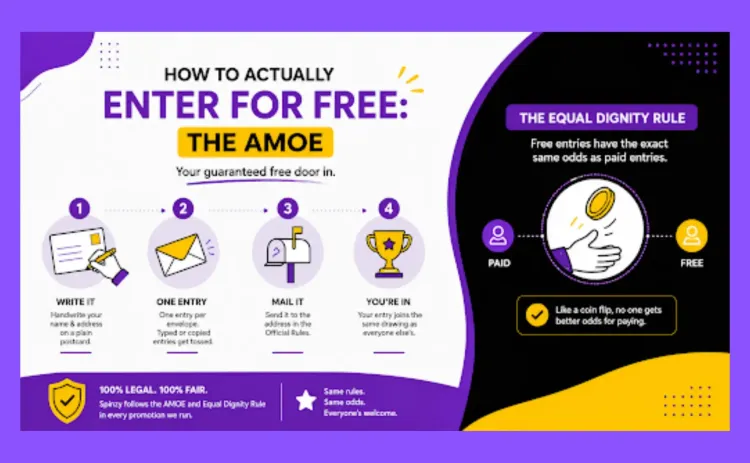
Every legal sweepstakes needs an Alternative Method of Entry, or AMOE. Think of it as your guaranteed free door in. Mail-in entries. Free online forms. Social media actions.
The mail-in method has real history. You have probably heard of the McDonald's Monopoly promotion, where players who did not want to buy food could mail in a handwritten entry to get game pieces, following the same odds as anyone buying a burger. That is the AMOE, quietly doing its job.
Want to try it? Write your name and address by hand on a plain postcard. Keep it handwritten, since typed or photocopied entries get tossed almost every time. Send one entry per envelope, and mail it to the address in the Official Rules. Your entry joins the same drawing as everyone else's.
Which brings us to the equal dignity rule, arguably the most important idea here. Free entries must have the same odds as paid entries. Picture a coin flip. Nobody gets heads more often just because they paid for the coin. Spinzy applies this rule to every promotion it runs, not just as a legal formality.
Skill vs. Chance
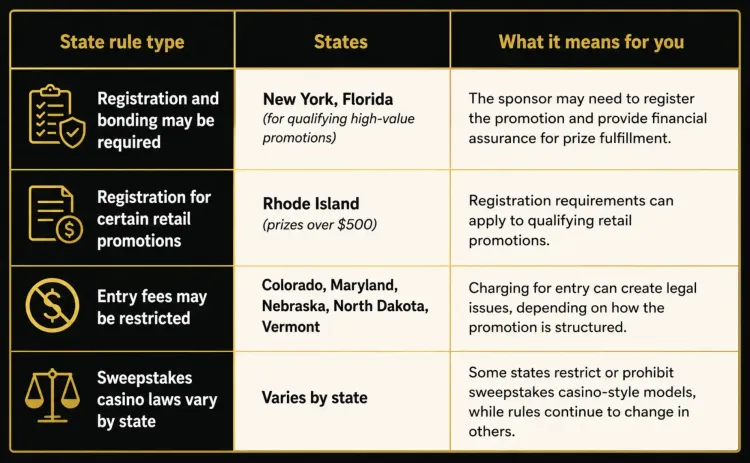
Not every fee-based contest is illegal. Skill contests- a photo competition, a trivia challenge, can charge a fee since the winner is chosen by merit, not luck. But Colorado, Maryland, Nebraska, North Dakota, and Vermont ban entry fees even for skill contests. Where you live can genuinely change whether a fee is legal at all.
No Purchase Necessary Law by State
State rules shift more than people expect. Treat this table as a starting point, and always check a platform's current Official Rules for your specific state.
How Free Entry and Taxes Work at Spinzy
Spinzy runs on this framework, not around it. Players must be 18 or older and located in the US, outside restricted states. Coins earned through free promotions, daily rewards, referral bonuses, and free spins can be redeemed once you hit the required minimum balance, up to a set limit for promotional-only winnings.
Every redemption goes through identity verification, or KYC. It might feel like an extra step, but it protects real players and keeps the Spinzy system fair, not slow for no reason. Most requests are reviewed within about a day.
Win a prize worth $600 or more anywhere, not just at Spinzy, and the IRS gets involved, usually through a Form 1099 MISC. And any legitimate giveaway always publishes its Official Rules somewhere findable. No visible rules are a red flag, not a technicality. Check Spinzy's current Official Rules for exact figures, since these get updated.
For those exploring reward-based platforms, Spinzy currently offers the promo code Spinzy7, which adds 7% extra to both Sweeps Coins and Gold Coins. It's a small promotional detail worth knowing if you're looking at ways to maximize the coins available to you.
Conclusion
No purchase necessary isn’t fine print meant to confuse anyone. It is a real law, built on a real formula, enforced by real agencies, with state-by-state differences most articles never mention. Whether you enter by mail, online, or through gameplay at Spinzy, your odds do not change based on whether you spent a dime.
Ready to see it for yourself? Explore Spinzy today, check out our Official Rules, and play knowing the law has your back.
FAQs
1. Is no purchase necessary law really true, or just marketing?
It is true. US law requires a free entry method with the same odds as any paid entry.
2. What is this law based on?
This law on no purchase is based on anti-lottery laws from the mid 1800s, enforced today by the FTC, FCC, USPS, and State Attorneys General.
3. Do free entries really have the same odds as paid ones?
Yes, under the equal dignity rule. Free entries cannot legally get worse odds.
4. Do I owe taxes if I win?
Prizes worth $600 or more typically come with a Form 1099 MISC, reportable as income.
5. Is a sweepstakes casino like Spinzy the same as gambling?
No. Removing consideration, meaning no required payment, is exactly what separates a sweepstakes casino from traditional gambling under US law.
This article is for general information only and is not legal advice. Laws vary by state and can change, so check current Official Rules for any promotion you enter.
Authored and Validated by: A Sweepstakes Gaming Expert