If you were to ask 10 slot machine players why some slots feel more distinct from others, many would say that it is because of the theme of the slot or perhaps the bonus round. What they rarely mention is the slot's volatility level. It's the reason one game keeps you topped up spin after spin, while another leaves you waiting, then hits so big it's almost unfair to compare the two. Once you know what's going on underneath, choosing between low volatility slots and high volatility slots stops being a guessing game.
What Slot Volatility Actually Means
Slot Volatility, or variance if you've heard it called that, is a measure of risk. Two things, really: how often a slot game pays, and how big that payout tends to be. Nobody hands you this information when you sit down to play, so most people learn it the hard way, by losing a session's worth of coins on a game that was never built for quick, steady wins.
A low volatility slot plays smooth. Small bumps, a fairly even ride. A high volatility slot behaves more like a long climb with nothing happening, then a sharp drop that catches you off guard. Neither style is right or wrong. It's about what you actually want out of the next twenty minutes.
There's a fixed piece underneath all of this: the random number generator, or RNG, running behind every spin. It's set at the game's design stage, and it decides the volatility before a single player ever touches the screen. No streaks, no lucky timing, no "it's due" logic changes that. The only real decision left to you is how you manage a session around numbers you can't influence.
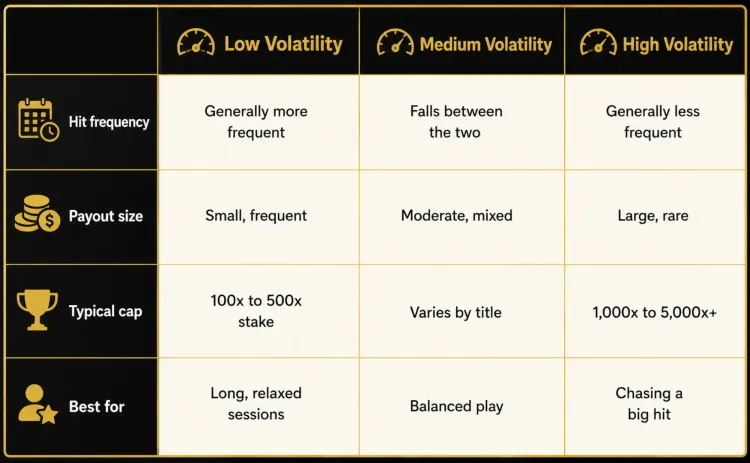
High, Low, and Medium Volatility Slots at a Glance
How Low Volatility Slots Actually Play
Low volatility pays in small amounts, but often, which is exactly why sessions on these games feel unhurried. You're not staring at a dead screen wondering if the machine's broken. Wins land regularly enough to keep things moving, even if none of them are life-changing. This makes low volatility a natural fit for anyone newer to slots, or anyone who just wants a longer, lower-stress session.
How High Volatility Slots Actually Play
High volatility test your patience before they reward it. Twenty, thirty, even fifty spins can pass without anything landing, and that stretch is part of the design, not a glitch. When a payout finally arrives, it tends to be worth the wait. This is the category most progressive jackpots belong to, and the players drawn to it usually accept the dry spells as the cost of chasing something bigger.
Medium volatility splits the difference: some quiet stretches, but shorter ones, paired with wins that run ahead of what low volatility typically pays.
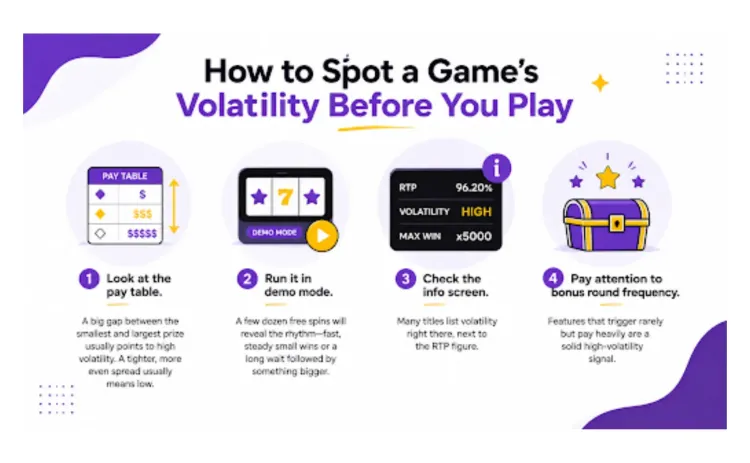
How to Spot a Game's Volatility Before You Play
A few quick checks, none of which require any special knowledge:
- Look at the pay table. A big gap between the smallest and largest prize usually points to high volatility. A tighter, more even spread usually means low.
- Run it in demo mode. A few dozen free spins will reveal the rhythm fast, steady small wins or a long wait followed by something bigger.
- Check the info screen. Many titles list volatility right there, next to the RTP figure.
- Pay attention to bonus round frequency. Features that trigger rarely but pay heavily are a solid high-volatility signal.
Volatility Isn't the Same as RTP
These two terms get mixed up constantly. RTP, or return to player, is a long-run figure that shows what percentage of coins played a game is designed to return over time. A 96% RTP means that, over millions of spins, the game returns 96 coins for every 100 coins played not something you'll see reflected in a single sitting at your phone.
Volatility is what shapes how that payback actually shows up while you're playing. Two games can carry the same 96% RTP and still feel like completely different games, one paying in small, frequent amounts, the other holding out for a longer stretch before delivering something bigger. The math is identical. The experience isn't.
Managing a Session With Some Strategy
A guideline some experienced players use for high volatility: prefer to start with a larger coin balance, which helps to get through a cold stretch without running out early.
On low volatility, there's more room to play at a relaxed pace since wins come more regularly anyway. On high volatility, pacing matters more; stretch your coins out, since you're playing for a longer-odds outcome rather than a quick return. When in doubt, the pay table usually answers the question faster than anything else.
Playing Volatility on Spinzy
Spinzy runs on a free-to-play sweepstakes model built for exactly this kind of experimenting. You can move between low volatility, medium volatility titles, and high volatility using Gold Coins, with no purchase required to get started. Sweeps Coins, earned through ongoing promotions, can be redeemed for prizes where eligible under the platform's terms, which is part of what makes the no-purchase-necessary sweepstakes format different from a real-money casino floor.
For players looking for an extra promotional boost, Spinzy currently offers the promo code Spinzy7, which adds 7% extra to both Sweeps Coins and Gold Coins, subject to the applicable promotional terms. It's another option to consider when exploring the platform's different slot games.
For US players specifically, that distinction matters. Sweepstakes-style platforms like Spinzy operate under a different legal framework than state-licensed real-money gambling, which is exactly why it's worth understanding the rules of the format you're actually playing, not assuming it works the same as a casino you've visited in person.
However you choose to play, keep it in check. Set limits for yourself, take breaks, and treat it as entertainment first.
Ready to Try It Yourself? Head to Spinzy and spin through low, high, and medium volatility slots today, no purchase necessary.
FAQs
1. Is high or low volatility the better choice?
Neither is objectively better. It comes down to whether you'd rather win small and often or wait longer for a bigger payout.
2. Can a slot's volatility be changed?
No. It's built into the game's RNG from the start and can't be adjusted by a player or a platform.
3. Does volatility affect my odds over time?
Not the overall math; that's what RTP measures. Volatility only changes how those returns get delivered while you play.
4. What's a good hit frequency to look for?
It depends on your style. Around 20-30% suits players who want frequent action. Around 10-15% suits players chasing bigger, rarer wins.
5. Does the volatility differ on a free-to-play sweepstakes gaming site such as Spinzy?
No. The volatility is already programmed into the game through the RNG, whether you are playing with gold coins, sweepstakes coins, or money. Everything remains the same except for how you receive your winnings.
Authored and Validated by: A Sweepstakes Gaming Expert