
You noticed that the wheel spun and thought, "Is there a better way to play than by simply picking a number and hoping? One of the most looked-up roulette strategies in casino gaming is roulette strategy. Players like structure; not a guess in a suit of confidence.
Martingale, Fibonacci, D'Alembert, Paroli, Labouchère, James Bond, Oscar's Grind. There are 7 names and 7 ways of laying a bet, but none of these alters the action of the wheel. None of these systems comes close to the house edge. Just say it right from the start and set it aside.
But some of them really assist you in managing a session. This is the true essence of it, and it's important to understand before playing.
What is a roulette strategy?
A roulette strategy is a plan for how much to put your chips and when to raise or lower that bet, based on what happened on previous spins. The wheel has no memory. Past spins don't affect future ones, no matter how convincing the pattern looks.
Every playing system is a plan bolted onto a fixed set of odds. The odds never move, whatever system rides on top of them.
Here's the math. On a single-zero wheel, a straight bet on one number hits about 1 in 37 times. On a double-zero wheel, it's 1 in 38. Those extra pockets are where the house edge lives.
Expected value is the average result you'd land on if you placed the same bet thousands of times. On a single-zero wheel, the house edge sits around 2.7%. On double-zero, it climbs to roughly 5.26%. That gap looks small on paper. Over hundreds of spins, it adds up fast.
No progression, however clever, erases that edge. Systems change how your money moves without touching the wheel.
Why Players Use a Roulette Strategy
Bankroll management is the real reason smart players bother with a system at all. Without one, it's easy to bet on impulse and burn through funds in minutes.
A solid roulette strategy guide isn't selling a way to beat the casino. It's teaching structure.
Betting progressions split into two camps.
Positive progression means you raise your bet after a win. Paroli and Oscar's Grind work this way, riding a streak while it lasts and pulling back the moment it ends.
Negative progression means you raise your bet after a loss, usually trying to recover past losses with one win. Martingale and Labouchère are the classic examples. Run into a long losing streak on one of these, and your balance can drain fast.
Emotional discipline matters more than the math itself. A system hands you rules to follow so you're not chasing losses on tilt. That's genuinely useful. Just don't mistake discipline for an edge.
One more thing before the examples below: every bet size is shown in units rather than dollar amounts, since Spinzy runs on Gold Coins and Sweeps Coins rather than cash wagers. Swap "unit" for whatever coin amount fits your session.
Roulette strategy comparison table
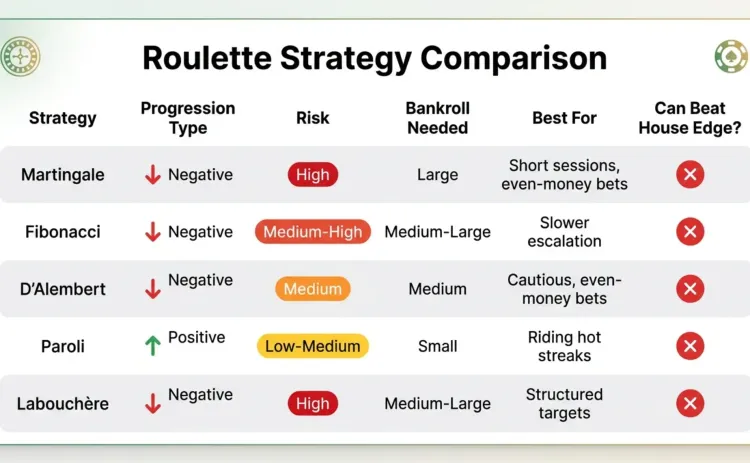
Roulette Strategies Explained
Martingale strategy
Double your bet after every loss. Win once, and you recover every loss along the way plus a small profit equal to your original stake.
Bet 1 unit and lose, bet 2 and lose, bet 4 and lose, bet 8 and win: you're up 1 unit for the whole run.
Simple math, and it works fine over short bursts with a healthy balance behind it. But losing streaks run longer than people expect, and Martingale punishes that harder than any other system here. 6 straight losses on a 1-unit base bet push your next wager to 64 units, which is where bet limits and balances both tend to give out.
This one's for players with a large balance and a short session in mind, betting on even-money outside numbers where a quick recovery actually has a shot.
Paroli strategy
Flip Martingale on its head and you get Paroli. Double your bet after a win instead of a loss, and reset after a loss or after 3 straight wins.
Bet 1 and win, bet 2 and win, bet 4 and win: reset to 1.
Cold streaks cost you no more than your base bet, which is the whole appeal. The catch is it needs a real winning streak to pay off, and streaks show up on their own schedule, not yours.
Low to medium risk, best for players happier capping the downside than chasing a bigger upside.
Fibonacci strategy
Bet sizes follow the Fibonacci sequence: 1, 1, 2, 3, 5, 8, 13, and so on. Lose, and you step forward one place in the sequence. Win, and you step back two.
Bet 1 and lose, bet 1 again and lose, bet 2 and lose, bet 3 and win: you drop back two steps for your next bet.
It climbs gentler than Martingale, so a rough patch doesn't drain your balance quite as fast. The downside is recovery takes longer too, since each win only covers part of what came before it.
Medium-high risk, but a reasonable pick for players who want a negative progression without Martingale's steep, unforgiving curve.
D'Alembert strategy
This one's flatter than Martingale by a wide margin. Raise your bet by 1 unit after a loss, lower it by 1 unit after a win, and that's the whole system.
Bet 10 and lose, bet 11 and lose, bet 12 and win: your next bet drops to 11.
It leans on one assumption: that wins and losses even out over time. That's not guaranteed in any single session, but the volatility stays lower than most negative progressions, so a bad run doesn't hurt as much.
A medium-risk pick, and a good fit for cautious players who still want structure without a steep climb.
Labouchère strategy
Write down a sequence of numbers that adds up to your target profit, then bet the sum of the first and last numbers in the line.
Say your sequence is 1, 2, 3, 4: bet 5 (that's 1 plus 4), win, and you cross off both ends, left with 2, 3, then bet 5 again.
Lose instead, and the lost amount gets tacked onto the end of the sequence. String together a few losses and the required bet climbs fast, faster than most players expect going in.
High risk, but it gives you something Martingale doesn't: a defined, trackable target instead of open-ended betting.
James Bond strategy
Named for its inventor's fictional namesake, this one covers multiple outcomes in a single spin instead of chasing one number. A common split: 14 units on high numbers (19 through 36), 5 units on the six-line (13 through 18), and 1 unit on zero as a hedge.
With a 20-unit total, you're covering 25 of the wheel's 37 or 38 numbers in one go.
That wide coverage means wins land more often, even if any single win pays less. Numbers 1 through 12 aren't covered at all, though, and the bet stays fairly large every round no matter what.
Medium risk, aimed at players who'd rather win small and often than gamble on a rare, big payout.
Oscar's Grind
Patience is the whole strategy here. Raise your bet by 1 unit only after a win, and only when you're not already ahead for the session; stay flat after every loss.
Bet 10 and lose, bet 10 again and lose, bet 10 and win (still down overall), bet 20 and win: the session closes 1 unit ahead.
It's slow by design, built around small, repeatable goals instead of big swings. Progress can crawl though, and a bad losing streak still chips away at your balance before recovery even starts.
Low risk, and probably the best match for patient players who value session length over jackpot dreams.
Flat betting
No sequence to remember, no math to track. Bet the same amount every spin, win or lose, and the number never moves.
Bet 10. Win, bet 10. Lose, bet 10 again.
It's the easiest system to hold a budget with, and there's zero risk of a bet size running away from you. Some players miss the ability to chase a loss or ride a streak; plenty of others count that as the whole point.
Low risk, and probably the strongest default for newer players who want the simplest bankroll management possible.
European vs American Roulette
The wheel matters more than any betting system stacked on top of it.
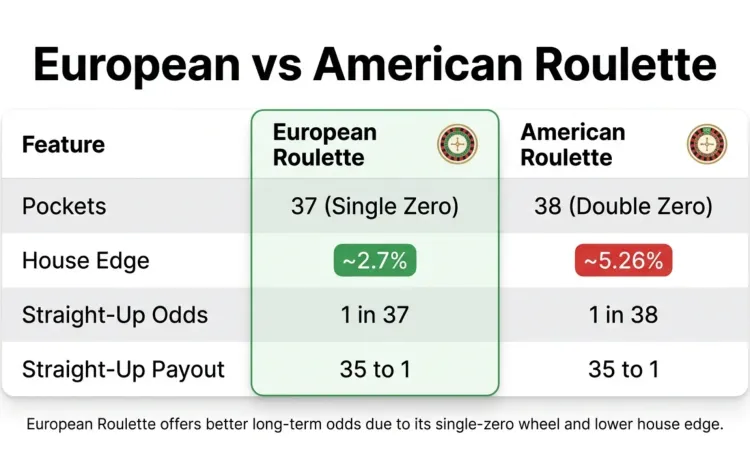
That extra double zero on American wheels doesn't touch the payout table. It just gives the house one more way to win, which is why the house edge nearly doubles on double-zero wheels.
Given a choice, European roulette hands you better long-term odds. Same bets, same payouts, one fewer pocket working against you.
Common roulette myths
1. Martingale guarantees profit
It doesn't. It works right up until a losing streak outpaces your balance or the bet limit, and that streak shows up eventually.
2. Hot numbers stay hot
Each spin stands alone. A number hitting 5 times in a row has no better shot at a 6th hit than any other number on the wheel.
3. Dealers control outcomes
Licensed roulette games, live or digital, run on certified random number generators or physically fair wheels. Nobody's steering the ball.
4. Betting systems beat probability.
No system touches the underlying odds. They only change how your bets are sized.
5. Previous spins affect future ones.
This is the gambler's fallacy in its purest form. The wheel forgets every spin the second it ends.
What the math actually shows
Skip the hypothetical case study. Look at the numbers directly.
Take a Martingale sequence starting at 1 unit: 1, 2, 4, 8, 16, 32, 64.
6 losses in a row isn't rare over a long session. Bet number 7 needs to land at 64 units just to recover 63 units in losses and clear 1 unit of profit. Most bet limits cap out long before that point, and even without a posted limit, your balance has one of its own.
The same wall shows up in every negative progression, not just Martingale. Fibonacci and Labouchère climb slower, but enough losses in a row and the required bet outgrows what you can afford or what the game allows.
Positive progressions like Paroli and Oscar's Grind sidestep that trap since you're never risking more than you're willing to lose on a single spin. The tradeoff is smaller, slower gains.
Sweepstakes considerations
Sweepstakes gaming runs on different rails than a traditional online casino, and it's worth understanding the structure before you sit down at a roulette table on a sweepstakes platform.
Most sweepstakes casinos use two currencies. Gold Coins are for entertainment play only and can't be redeemed for cash. Sweeps Coins can typically be redeemed for cash prizes where permitted by law, often earned through free entry methods required under sweepstakes rules.
Prize redemption depends on your state or region. Not every jurisdiction allows it, so check local eligibility before you play.
Responsible gaming applies here just as much as it does anywhere else. Set a budget. Take breaks.
Treat betting systems as tools for pacing a session, nothing more.
Compliance matters too. Reputable sweepstakes platforms publish their official rules, eligibility requirements, and odds disclosures. Read them before you play.
Expert insight
The roulette strategy earn their keep in one place above all: managing how you play a session. Flat betting, D'Alembert, and Oscar's Grind help pace a balance and smooth out the swings.
Martingale, Fibonacci, and Labouchère promise faster recovery after a loss, but they ask you to shoulder more risk to get it. None of them predicts where the ball lands.
Want a longer session on a fixed budget? Pick something low-volatility.
Chasing quick recovery after a loss? Understand what you're trading: a small chance of a big setback for a bigger chance of a small win. That's the real tradeoff. No hidden formula underneath it.
Conclusion
The best roulette strategies won't touch the house edge. Anyone claiming otherwise is selling something. What they can do is help you manage a balance and play with more discipline than betting on impulse ever allows.
Pick a system that fits your risk tolerance. Flat betting and D'Alembert suit players who want a steady, controlled session.
Paroli and Oscar's Grind suit players chasing modest gains during a hot streak. Martingale, Fibonacci, and Labouchère suit players comfortable with bigger swings for a shot at faster recovery.
Whatever you pick, set a budget first and hold to it. Play responsibly.
If you're ready to explore roulette on Spinzy, you can also use the current promo code Spinzy7, which adds 7% extra to both Sweeps Coins and Gold Coins, subject to the applicable promotional terms. Check the current offer details before claiming it.
Ready to play? Explore Spinzy's roulette games and enjoy a fun sweepstakes gaming experience.
FAQs
1. What is the best roulette strategy?
No strategy beats the house edge. Flat betting and D'Alembert rank among the safest for managing a balance over a long session.
2. Can any roulette system beat the house?
No. Every system changes bet sizing. The odds stay exactly where they were, and the house edge holds steady no matter the strategy.
3. Does the Martingale strategy really work?
It can post small, quick wins over short sessions. Stretch it out long enough, and a losing streak eventually outruns the doubling, wiping out gains or more.
4. Which roulette version has the best odds?
European roulette, thanks to its single zero. The house edge sits around 2.7%, against roughly 5.26% on American double-zero wheels.
5. Is roulette luck or skill?
Luck. Each spin is an independent, random event. Betting systems only ever touch how you manage money, never the outcome of the next spin.