
Roulette comes down to one loop: pick a bet, place it before the spin, watch the ball land, then check the paytable.
This guide covers the table layout, the bets and their odds, wheel differences, and what to check before you play on a sweepstakes platform.
The Roulette Table Layout
Before placing a bet, learn what you're looking at. A standard European wheel has 37 pockets, numbered 0 through 36. Numbers 1 to 36 alternate red and black. The 0 is green.
American roulette adds a second green pocket, marked 00, for 38 pockets total. The betting layout next to the wheel mirrors those numbers.
Number grid
Numbers 1 through 36 sit in 3 columns. This is where you'll find inside bets: straight-up, split, street, corner, and six-line.
Zero
The green 0 sits outside every other category: not red or black, not odd or even, not high or low.
American roulette adds 00 on top of that, which changes the math.
Outside betting areas
These sit around the main number grid:
- Red or black
- Odd or even
- 1 to 18, or 19 to 36
- 3 dozens
- 3 columns
Outside bets cover larger groups of numbers. That's why they hit more often and pay less than a single-number bet.
Dozens
The table splits into 3 groups:
- 1 to 12
- 13 to 24
- 25 to 36
A dozen bet covers 12 numbers and pays 2:1.
Columns
The 3 vertical sections each hold 12 numbers. A column bet also pays 2:1.
How Roulette Works
Roulette is a chance game built around one spin
In a live game, the dealer spins the wheel one way and sends the ball around the other way. Players bet before the betting period closes. Whichever pocket catches the ball wins.
Online roulette splits into 2 formats
RNG roulette uses a Random Number Generator to pick the outcome electronically. A properly tested RNG produces results that are unpredictable and unbiased. Independent labs, like Gaming Laboratories International (GLI), test these systems for randomness, distribution, and independence.
Live dealer roulette streams a real wheel and a real dealer to your device. The result comes off that physical wheel, not a simulation.
Roulette Rules For Beginners
Every round follows the same 7 steps.
- Choose your roulette version and check its rules.
- Place your bets before the betting period closes.
- The wheel spins and the ball drops in.
- It lands in one numbered pocket.
- The paytable determines which bets win.
- Losing bets come off the table.
- Next spin, new round.
Each spin is independent. A run of red doesn't make black "due." A number that's been quiet for 20 spins isn't suddenly more likely to hit.
The wheel has no memory of the last spin.
Inside vs Outside Roulette Bets
Every roulette bet is either an inside bet or an outside bet.
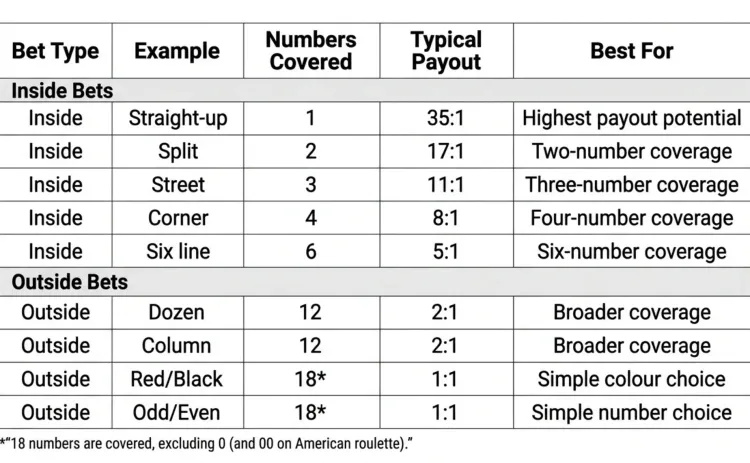
On a European wheel, 0 belongs to neither colour and counts as neither odd nor even.
Inside bets cover fewer numbers and pay more. Outside bets cover more numbers and pay less.
Roulette Bets and Payouts, Explained
Here's what the main bets mean on the felt.
Straight-up
One number, like 17. Pays 35:1. About a 2.70% chance of hitting on a European wheel.
Split
Two adjacent numbers. Pays 17:1.
Street
Three numbers in one row. Pays 11:1.
Corner
Four numbers that meet at one point. Pays 8:1.
Six line
Two adjacent rows, six numbers total. Pays 5:1.
Dozen
1-12, 13-24, or 25-36. Pays 2:1.
Column
One of the 3 vertical columns. Pays 2:1.
Red or black
One color, red or black. On a European wheel, 18 of the 37 pockets are each color, a 48.65% shot, not a clean 50/50, since the 0 belongs to neither. Pays 1:1.
How To Play Roulette, Step By Step
Once you know the layout and the bets, it's 4 steps.
1. Choose your game
Check whether you're playing European, American, or another variation. Look at the zero pockets, bet minimums, and paytable before you start.
On sweepstakes platforms, also check whether the game runs on Gold Coins (GC), Sweeps Coins (SC), or both. Read the platform's rules for each.
2. Pick your bet
Click or tap the section that matches your bet: red, black, odd, even, a dozen, a column, or a single number.
Most games let you place more than one bet per round.
3. Wait for the spin
The wheel spins once betting closes. Software decides the result in an RNG game. In a live dealer game, the physical wheel does.
4. Check the result
The ball lands in one pocket, and the paytable decides which bets win and what they pay.
That's the whole process.
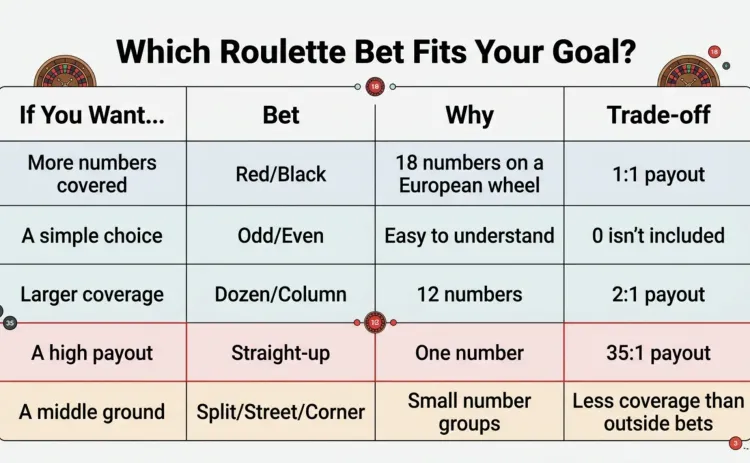
Which Roulette Bet Fits Your Goal?
No bet guarantees a win. Each one trades off differently: how many numbers it covers, how often it hits, and what it pays.
European vs American Roulette
The number of zero pockets makes a real mathematical difference.
Roulette version
European
Pockets: 37
Standard house edge: 2.70%
American
Pockets: 38
Standard house edge: 5.26%
European roulette has one green 0. American roulette has both 0 and 00.
That extra pocket drops the odds on every bet and pushes the house edge from 2.70% to 5.26%. Given the choice, single-zero is always the better house edge.
Some French tables add a rule called La Partage on even-money bets. If the ball lands on zero, you get half your bet back instead of losing the whole thing. That roughly halves the house edge on those bets, down to about 1.35%.
Check the specific table's rules before you sit down. Not every game labeled "European" or "French" plays the same way.
Why Roulette Odds Matter
A payout ratio tells you what you'd win. It doesn't tell you how likely you are to win it.
Take a straight-up bet on European roulette: one winning pocket out of 37, about a 2.70% chance. The payout is 35:1.
Now take red: 18 pockets out of 37, a 48.65% chance. The payout is only 1:1.
That's the trade-off across the whole game. Cover fewer numbers and the payout goes up. Cover more numbers and it goes down.
No pattern of bets changes the wheel's odds.
Common Roulette Mistakes Beginners Make
Chasing losses
After a few losses, it's tempting to bet bigger and try to win it all back in one spin. That raises how much you have on the table without doing a thing to your odds.
Betting too much too early
A small bet teaches you the table just as well as a big one. Set your session budget first, then pick a stake that fits inside it comfortably.
Looking for hot or cold numbers
A number that's been quiet for 20 spins has no memory of being quiet. Each spin starts fresh, with the exact same odds as the one before it.
Ignoring the wheel type
One glance at the wheel tells you whether it's single-zero or double-zero. That one difference swings the house edge by almost double.
Treating betting systems as guarantees
Martingale, Fibonacci, and other systems are really just rules for sizing your next bet. The house edge sits at 2.70% on a European wheel or 5.26% on an American one, no matter which system you're following.
What To Check Before Playing Roulette Online
Good graphics don't tell you whether a game is fair. Check these instead:
- Roulette version: European, American, French, or another variant
- Zero pockets: One, two, sometimes more in speciality variants
- Paytable: Confirm the exact payouts
- RNG info: for RNG games, look for testing and fairness details
- Live dealer details: Check the game rules and studio info
- Bet limits: Make sure the minimum and maximum fit your session
- Platform terms: How the game works with GC and SC
- Eligibility: Whether the platform is available where you are
- Sweepstakes Rules: Covers SC promotions, play, and redemption
- Responsible-play tools: Limits and player-protection features, if offered
For RNG games, look for evidence of independent testing, like GLI certification. That's the strongest signal the system's actually been checked for randomness and bias.
Sweepstakes Roulette: What To Know First
Sweepstakes roulette can work differently from traditional real-money casino play.
Platforms may use 2 virtual currencies: Gold Coins (GC) for entertainment play, and Sweeps Coins (SC) for eligible sweepstakes participation. The exact mechanics, promotions, and redemption rules depend on the platform.
Before playing, check the platform's:
- Official Sweepstakes Rules
- Terms and Conditions
- Eligibility requirements
- State availability
- Currency rules
- Promotion terms
- Redemption requirements
Rules and availability vary by state, and they can change. A platform available in one state isn't guaranteed to work in the next one over.
Check the platform's current rules directly before you play.
Roulette Risks and Responsible Play
Roulette is a game of chance. You pick the bet and the stake. The wheel picks the number. There's no strategy that guarantees consistent wins. Treat roulette as entertainment. The house edge means it can't reliably generate income, no matter how you play it.
Set a budget before you sit down. Skip the loss-chasing. Stop when it stops being fun.
Most importantly, don't raise your stake just because the last few spins went against you. The wheel doesn't adjust for what already happened.
Expert Insight: Learn the Table Before the Systems
Learn the table layout before anything else. It does more for a beginner than any betting system.
Spot a straight-up, split, street, corner, dozen, column, and even-money bet on sight, and the whole table gets easier to read.
Then learn the probabilities. Knowing red covers 18 of 37 pockets tells you more than any system claiming a colour is "due."
The math sharpens every choice you make at the table: which bet to place, how much to risk, what you're actually getting for your money.
Bottom Line
You now know the grid, the inside and outside bets, the payouts, and where the zero sits.
Pick a game, learn its rules, place your bet before the spin, and check the result against the paytable. That's the whole game.
On a sweepstakes platform, check one more thing: the current eligibility rules, Sweepstakes Rules, currency mechanics, and redemption terms.
And remember the one rule that matters most: roulette is random, and no betting system beats that.
Ready to put your knowledge to use? Explore roulette on Spinzy.
FAQs
Is roulette based on skill or luck?
Luck. You choose the bet, the wheel decides the rest. Knowing the odds makes you a sharper bettor.
What's the best roulette bet for beginners?
Outside bets like red/black and odd/even are the easiest starting point. They cover more numbers and hit more often than a straight-up bet. They also pay less.
What's the safest bet in roulette?
Even-money bets like red/black come closest. On a European wheel, they cover 18 of 37 pockets, a 48.65% shot per spin. The house edge is the same as it is on every other bet.
What's the difference between European and American roulette?
European roulette has 37 pockets, 0 through 36. American roulette adds a second zero for 38. House edge: 2.70% for European, 5.26% for American.
Is an online roulette game fair?
Depends on the platform and its controls. A properly tested RNG produces outcomes that are unpredictable and unbiased. Look for independent testing, licensing, or regulation, and read the platform's published game rules.
Can I play roulette on sweepstakes platforms?
Some sweepstakes platforms have roulette for eligible users. Availability, age rules, state restrictions, and redemption terms all vary by platform, so check the current official rules before you play.
How long does it take to learn how to play roulette?
A few rounds gets you the basic mechanics. Learning every bet, payout, and wheel variation takes longer. The core rules stay simple the whole time.
Does a roulette wheel remember previous spins?
No. Every spin is independent. A streak of reds doesn't make black more likely next time, and a number that's been quiet for a while isn't "due" either.