
Ever noticed a line buried in a sweepstakes promotion mentioning a free way to enter by mail? That option has an actual name and a real legal purpose: AMOE. Sweepstakes operators can't make a purchase the only way in. State and federal consumer protection rules see to that. Most players skip right past this detail without ever learning what it means or why it's there in the first place. Some assume it's a loophole. It isn't. This article walks through the legal reasoning behind it, how the mailed-request process actually plays out, and how to tell a properly disclosed free entry from one that just looks compliant on paper.
Why Sweepstakes Include an Alternate Path to Entry
Consumer protection law in the US draws a hard line: a sweepstakes cannot require payment for a chance to win. Most states hold sweepstakes operators to this standard, often shortened to "no purchase necessary." Skip the free option, and the promotion stops looking like a sweepstakes and starts looking like an unlicensed lottery. That's a real distinction under the law, not just wording.
So operators build in a path that costs nothing to use, one that carries the exact same odds as a paid entry. AMOE, short for Alternative Method of Entry, is the industry's name for that path. It is not a loophole or a workaround. It is a structural requirement built into how legal sweepstakes are designed from the ground up.
Regulators generally expect this free option to be reasonably accessible, clearly explained in the official rules, and treated with equal standing to any entry obtained through a purchase. A platform that buries this information or makes the free method excessively difficult to use may draw regulatory scrutiny.
How the AMOE Process Works
The exact steps for AMOE sweepstakes participation vary somewhat between operators, but most follow a pattern rooted in longstanding sweepstakes practice. Such as:
- Full name, mailing address, date of birth, and any other identifying detail the official rules call for usually have to go in the request.
- That address is often a PO box, run either by the sweepstakes sponsor directly or by an agent handling entries on their behalf.
- One envelope, one entry, is the standard most operators stick to. Want to submit three requests? That means three separate envelopes in the mail.
- A cap usually applies too, limiting how many entries one participant can submit within a day, week, or other stated period, largely to prevent bulk mailing from overwhelming the system.
- Processing time isn't fixed. Some operators credit an entry within a few business days; others take longer depending on mail volume and internal review. Verification requirements can also affect how quickly a redemption is processed, so understanding the sweepstakes casino verification process can help explain some payout delays.
Entry Limits and Timing Considerations
A mailed request simply can't move as fast as something submitted online, so a short wait before it shows up as confirmed is nothing unusual. The postal system adds a step that instant entry methods skip entirely. Most operators account for this in their official rules by publishing an expected processing window upfront. Before concluding that a request has gone unanswered, checking that stated window is the more reliable move than assuming the worst.
It is also worth noting that most operators apply per-period limits to free requests specifically to maintain fairness across their entire player base. A participant who wants to maximize their free entries over time should plan around these limits rather than attempting to submit far more requests than the rules allow, since excess submissions beyond the stated cap are typically disregarded.
Free Entry Versus Purchase-Based Participation
One of the most persistent misunderstandings about sweepstakes promotions is the assumption that paying for entry improves a participant's odds. Under proper sweepstakes design, this is not the case. A free entry obtained through the alternate method must carry the same statistical chance of winning as an entry obtained through a purchase. The entry itself, not how it was acquired, determines its standing in the promotion.
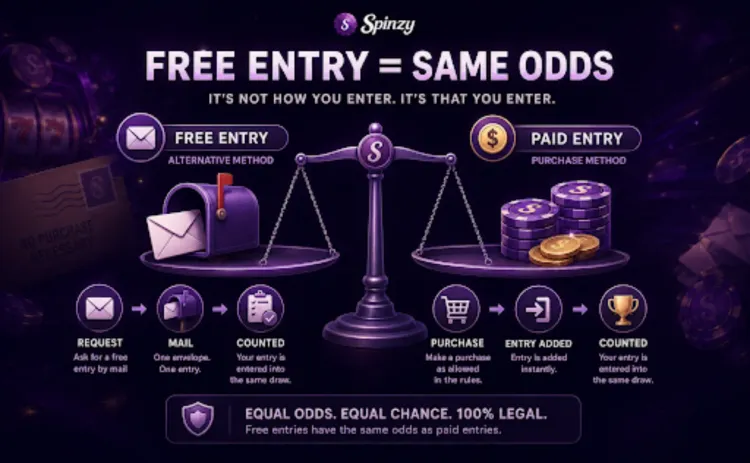
This equal treatment is a legal necessity rather than a marketing courtesy. If a sweepstakes operator gave paid entries better odds than free ones, the promotion could be reclassified as an unlawful lottery in many jurisdictions, since lotteries require payment, chance, and prize elements together in a way that ordinary sweepstakes are specifically structured to avoid. Reputable operators disclose this equal treatment directly in their official rules, and participants can generally rely on that disclosure as an indication of a properly structured promotion.
Common Misunderstandings About Free Entry
A number of misconceptions tend to follow discussions of free entry methods, and clearing them up is useful for anyone evaluating a sweepstakes platform.
- Free entry does not mean unlimited entry. Reasonable caps per person and per period are standard and legally acceptable.
- Mailing extra requests past the stated cap does not bank additional chances for later. Submissions beyond the limit are simply disregarded rather than held in reserve.
- Free entry is not optional under the law. A sweepstakes without any no-purchase option is not operating within standard legal requirements.
- The same platform can run different AMOE terms for different promotions. Reading the official rules for that specific promotion matters more than assuming the process is identical to one used before.
Recognizing these points helps participants evaluate whether a given platform's promotional structure is genuinely compliant or simply presented that way.
AMOE at Spinzy
Spinzy operates as an online sweepstakes platform and, consistent with standard industry practice, provides an alternate entry option described in its official sweepstakes rules. Entries obtained through this method are tracked separately from other promotional credits the platform issues, which reflects the broader industry principle that free entries should be identifiable and governed by their own clearly disclosed terms rather than folded into unrelated bonus categories.
For those exploring Spinzy, the platform also currently offers the promo code Spinzy7, which adds 7% extra on both Sweeps Coins and Gold Coins. Participants interested in this option should review Spinzy's published official rules directly, since specific submission details and any applicable limits are set out there.
Conclusion
Legally, AMOE is what separates a real sweepstakes from something that would otherwise resemble an unlicensed lottery. That distinction rarely gets discussed, yet it shapes every part of how these promotions are built. A mailed request takes longer to process than a digital one, sure, but the odds sitting behind it are identical either way. Anyone weighing whether a sweepstakes platform is playing by the rules can usually find the answer here: does the free entry actually get treated as an equal, or does the fine print quietly suggest otherwise? That single detail tends to reveal more than most other parts of an official rules page.
Ready to explore sweepstakes gaming? Visit Spinzy and get started.
FAQs
What does AMOE stand for?
It stands for Alternative Method of Entry, referring to the free participation option that sweepstakes operators are required to offer alongside any paid entry method.
Is using the free entry method different from paying for entry in terms of winning odds?
No. A properly structured sweepstakes gives entries obtained through the free method the same odds of winning as entries obtained through a purchase, since equal treatment is generally required for a promotion to remain lawful.
Why do sweepstakes require a mailed request instead of an online form for this option?
Many operators still rely on a mailed request because it has long been an accepted standard within sweepstakes law, though some platforms may offer additional free entry paths depending on how their specific promotion is structured. Reviewing the official rules for any given promotion clarifies exactly which options apply.
How many free entries can a participant typically submit?
This depends entirely on the limits published in a promotion's official rules, which commonly restrict submissions to a set number per day, week, or other defined period.
Where can someone find the exact AMOE sweepstakes instructions for a specific platform?
The official rules published by that platform are the authoritative source, since they contain the required mailing address, submission format, and any applicable entry limits for that particular promotion.
Authored and Validated By: A Sweepstakes Gaming Expert