Sweeps Coins are used to cash out for a prize. So the next question that arises is: Are they subject to taxes?
Things become complicated quickly with sweeps taxes, as virtual currency is not the same as prize redemptions, and reporting of taxes on virtual currency is complicated as well.
For the most part, the IRS views prizes and awards as income and taxable. A taxable prize is still taxable even if it does not include a tax form. It is what you get, how much you value it, plus your rules.
This guide covers Sweeps Coin redemptions, Form 1099-MISC reporting, the new $2,000 threshold for qualifying payments made in 2026, and how to keep records that actually hold up.
Do You Pay Taxes on Social Casinos?
Short answer: Potentially. If you receive a prize that counts as taxable income, you may owe something on it.
Here's where it gets confusing. Holding or using promotional virtual currency isn't the same as receiving cash or a prize with real value. A coin balance sitting in your account is just a coin balance.
What matters is what happens when you complete an eligible redemption. If you walk away with money or another prize, its value may count under U.S. tax rules.
And there's no single rule that treats every platform the same way. Structure, prize type, and your own tax situation all factor in.
The $2,000 Rule: What the 1099-MISC Threshold Means
You'll still see the old $600 figure floating around online. It's outdated. The reporting threshold changed for payments made after December 31, 2025.
For qualifying prizes and awards, Form 1099-MISC reporting generally kicks in at $2,000 or more for 2026 payments. That's an information-reporting rule. Whether a prize is taxable is a separate question, and prizes under $2,000 can still owe tax.
This distinction matters for anything you'll find searching "1099-MISC sweepstakes winnings." You can land well under $2,000 and still need to think about whether it's taxable income.
A reporting threshold and a tax-free threshold are different things entirely. Your obligations depend on the prize itself, whatever shows up (or doesn't) in your inbox.
How Are Sweeps Coin Redemptions Taxed?
People searching "tax on sweeps coins" often assume the coins themselves get taxed like cash. Usually the real issue is the prize or value you receive through an eligible redemption. The coin itself rarely matters for tax purposes.
Keep a simple spreadsheet with:
- Date of redemption
- Platform name
- Prize or redemption value
- Transaction or confirmation number
- Payment method
- Redemption confirmation email or screenshot
- Any Form 1099-MISC you receive
This gives you something to compare against any tax form you get, and it makes the conversation with a tax professional a lot shorter.
If you redeem often, track the running total through the year. Don't wait for tax season to reconstruct it.
What Should You Do at Different Redemption Amounts?
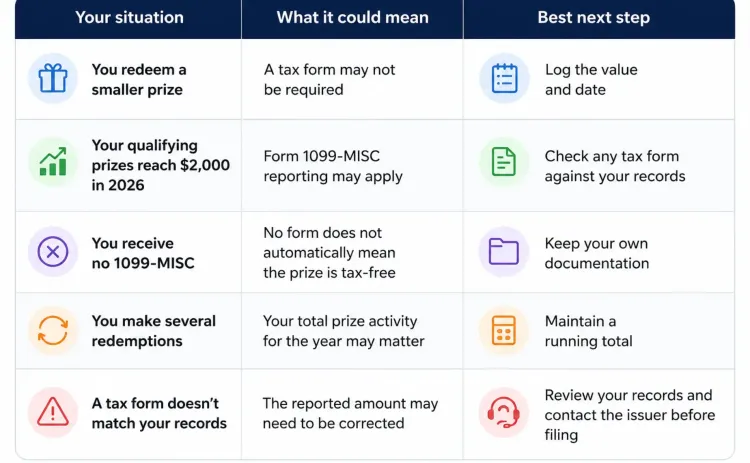
This beats treating sweepstakes casino taxes as a simple "under the limit, over the limit" math problem. It rarely is.
Example: Tracking Multiple Sweeps Coin Redemptions
Say a user completes three eligible prize redemptions in 2026: $400, $750, and $1,100.
Total recorded value: $2,250. Simple result: three dates, three values, one clear yearly record.
Depending on the facts and reporting rules, the payer might have an information-reporting obligation here. The user's own recordkeeping shouldn't wait to find out either way. Track it the day it happens.
This is a hypothetical example, for illustration only.
Can You Deduct Sweepstakes Coin Losses?
Be careful with this one. IRS rules on gambling winnings and losses come with their own limits and recordkeeping requirements, and sweepstakes activity doesn't automatically get the same treatment as traditional gambling.
Don't assume you can subtract promotional purchases or losses from a redeemed prize just because it feels like the same math as a casino trip. Sweepstakes activity often runs on its own set of rules.
If real money is involved, ask a qualified U.S. tax professional how deductions apply to your specific activity.
Sweepstakes Casino Eligibility, Legal Limits, and Compliance
Tax questions only come up after you've looked at the underlying activity and prize. But eligibility matters too, and it comes first.
Platforms typically require a minimum age, residency in an eligible jurisdiction, identity verification, and adherence to official rules. Redemption availability varies by location.
Read a platform's official rules before you participate or redeem. Give accurate info during verification, and hold onto your records in case the platform asks for compliance documentation later.
This affects whether you're eligible to redeem a prize in the first place. Your tax liability gets decided separately, by a different set of rules.
As an additional promotional option, Spinzy currently offers the promo code Spinzy7, which adds 7% extra to both Sweeps Coins and Gold Coins, subject to the applicable promotional terms. If you're exploring the platform, it's worth checking the current offer before participating.
Is There a Sweepstakes Casino Tax Rate?
There's no single percentage called a "sweepstakes casino tax." If a prize is taxable, what you actually owe depends on your total income, filing status, deductions, credits, and any applicable state or local rules.
A $1,000 redemption factors into your total income for the year and gets taxed at whatever rate that income lands you in.
The best habit: record the value the moment you receive a prize, save your documents, and get professional advice once the amount gets substantial or the treatment feels unclear.
The Bottom Line
Sweepstakes casino taxes get a lot clearer once you separate three things: the virtual currency, the prize from redemption, and the tax form used to report it. The $2,000 threshold for qualifying 2026 prizes tells you when a form gets sent. It says nothing about whether the prize is taxable.
Track every meaningful redemption. Save your confirmations. Compare them against any tax documents you get. And if you're sitting on a substantial prize or a redemption that doesn't feel clear-cut, talk to a qualified U.S. tax professional.
Still figuring out how sweepstakes gaming works? Start by learning what a sweepstakes casino is.
FAQs
1. Do sweepstakes casinos send a 1099?
They may. For qualifying prizes and awards, Form 1099-MISC reporting applies once the requirements are met. For 2026 payments, the general threshold is $2,000.
2. Do you pay taxes on social casinos?
Potentially. A taxable prize or award may need to go in your income even without a tax form.
3. Do you have to pay tax on Sweeps Coins?
Usually the real issue is the prize or value from an eligible redemption. The coin itself rarely factors in. Treatment depends on the facts and the applicable rules.
4. Is $600 in sweepstakes winnings tax-free?
No. $600 was the reporting threshold used before 2026. For 2026 payments, the general Form 1099-MISC threshold is $2,000. Neither number is a tax-free limit.
5. How much tax do you pay on sweepstakes winnings?
There's no fixed rate. If a prize is taxable, the amount depends on your overall income, filing status, deductions, credits, and other rules that apply to you.